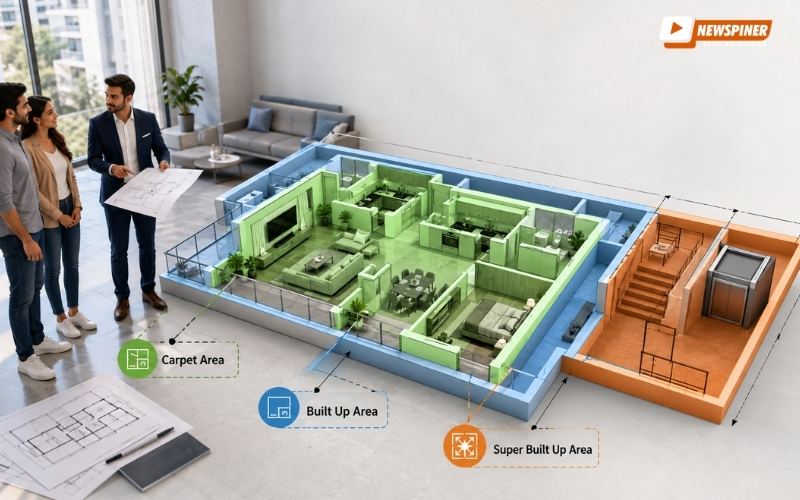
Buying a home is one of the biggest financial decisions most people make. Whether you’re purchasing your first apartment, investing in a property, or comparing multiple projects, you’ll often come across terms like Carpet Area, Built Up Area, and Super Built Up Area.
For many buyers, these terms can be confusing. Two apartments may both be advertised as 1,500 sq. ft., but when you visit them, one feels noticeably smaller than the other. This happens because the area mentioned in brochures or advertisements is not always the space you can actually use.
Understanding the difference between Built Up Area vs Carpet Area helps you know exactly what you’re paying for. It also allows you to compare different properties fairly and avoid misunderstandings during the buying process.
In this guide, we’ll explain everything in simple language with practical examples so you can make a confident property decision.
What is Carpet Area?
Carpet Area is the actual usable area inside your home. It refers to the floor space where you can place furniture, walk around, and live comfortably.
Simply put, if you spread a carpet across every usable room inside your apartment, the space covered by the carpet is called the Carpet Area.
It includes:
- Living room
- Bedrooms
- Kitchen
- Bathrooms
- Dining area
- Internal passages
- Store room
It does not include:
- External walls
- Balcony
- Terrace
- Veranda
- Open areas
- Common staircase
- Lift area
- Lobby
According to RERA (Real Estate Regulatory Authority), Carpet Area means the net usable floor area of an apartment, excluding external walls, service shafts, balconies, terraces, and open spaces, while including the area covered by internal partition walls.
This standard has made property buying much more transparent because builders now have to clearly mention the carpet area of a property.
You Can Also Read : What Is Pre Leased Property in Real Estate?
Why is Carpet Area Important?
Imagine you’re buying a sofa, dining table, wardrobe, and king-size bed. All of these need actual usable floor space.
The carpet area tells you:
- How much usable living space you actually get.
- Whether your furniture will fit comfortably.
- How spacious your rooms will feel.
- The true size of your apartment.
Many buyers mistakenly focus only on the total square footage without checking the carpet area. As a result, they may end up with less usable space than expected.
What is Built Up Area?
Built Up Area is larger than Carpet Area because it includes the carpet area along with the thickness of walls and certain additional areas attached to the apartment.
In simple words:
Built Up Area = Carpet Area + Wall Thickness + Balcony + Utility Area (if applicable)
It generally includes:
- Carpet Area
- Internal walls
- External walls
- Balcony
- Utility area
- Flower beds (in some projects)
It usually does not include:
- Lift
- Common lobby
- Clubhouse
- Garden
- Parking
- Staircases
- Shared amenities
Since walls occupy space, the built up area is always greater than the carpet area.
Generally, the built up area is around 10% to 20% larger than the carpet area, depending on the construction and design of the building.
You Can Also Read : Top-Rated Estate Agents in Norfolk
Example to Understand the Difference
Suppose you’re buying a flat advertised as 1,300 sq. ft. Built Up Area.
Here’s how it might look:
| Area |
Size |
| Carpet Area |
1,100 sq. ft. |
| Wall Area |
120 sq. ft. |
| Balcony |
80 sq. ft. |
| Built Up Area |
1,300 sq. ft. |
Although the flat is marketed as 1,300 sq. ft., the space where you can actually place furniture is only 1,100 sq. ft.
This is why understanding the difference is so important.
Built Up Area vs Carpet Area
| Feature |
Carpet Area |
Built Up Area |
| Includes usable floor space |
✅ Yes |
✅ Yes |
| Includes internal walls |
✅ Yes |
✅ Yes |
| Includes external walls |
❌ No |
✅ Yes |
| Includes balcony |
❌ No |
✅ Usually |
| Includes utility area |
❌ No |
✅ Usually |
| Actual living space |
✅ Yes |
Partially |
| Larger measurement |
❌ No |
✅ Yes |
| Used under RERA |
✅ Yes |
No |
Visual Understanding
Think of your apartment like this:
- The rooms where you live represent the Carpet Area.
- Add the thickness of the walls and the balcony, and it becomes the Built Up Area.
That’s why two apartments with the same built up area may offer different carpet areas depending on wall thickness and layout.
You Can Also Read : Greek Golden Visa Program: Residency by Investment Guide
Why Builders Mention Built Up Area
Many property advertisements highlight the built up area because it presents a larger number.
For example:
- Carpet Area: 1,000 sq. ft.
- Built Up Area: 1,180 sq. ft.
The larger figure often attracts buyers, even though the additional area mainly comes from walls and balconies rather than usable living space.
As a buyer, always ask for both measurements before making a decision.
How Built Up Area is Calculated
Although calculations vary slightly between projects, builders generally use this formula:
Built Up Area = Carpet Area + Wall Thickness + Balcony + Utility Area
For example:
- Carpet Area = 950 sq. ft.
- Wall Area = 120 sq. ft.
- Balcony = 80 sq. ft.
Built Up Area = 950 + 120 + 80 = 1,150 sq. ft.
Understanding this calculation helps you compare different properties more accurately instead of relying only on the advertised size.
Which Measurement Should Home Buyers Focus On?
If you’re purchasing a property for your family, the Carpet Area should be your primary consideration because it reflects the space you’ll actually use every day.
The Built Up Area is still useful, especially for understanding the property’s overall dimensions, but it shouldn’t be the only figure you rely on.
Before booking any apartment, compare:
- Carpet Area
- Built Up Area
- Price per square foot based on Carpet Area
- Balcony and utility space
- Overall layout efficiency
A well-designed apartment with a slightly smaller built up area can often feel more spacious than a poorly planned apartment with a larger built up area.
You Can Also Read : Top 10 Property Dealers in Mohali 2026
What is Super Built Up Area?
After understanding Carpet Area and Built Up Area, the next term you’ll often hear is Super Built Up Area. This is the number many builders use in brochures, advertisements, and price lists.
The Super Built Up Area is the total area of your apartment, including your built up area plus a share of the common spaces in the building.
These common spaces may include:
- Lobby
- Staircases
- Lift area
- Corridors
- Clubhouse (in some projects)
- Gym
- Community hall
- Security room
- Shared amenities
Since these facilities are used by all residents, the builder allocates a proportionate share of these areas to each apartment.
Formula
Super Built Up Area = Built Up Area + Proportionate Share of Common Areas
For example:
| Area |
Size |
| Carpet Area |
1,000 sq. ft. |
| Built Up Area |
1,180 sq. ft. |
| Common Area Share |
220 sq. ft. |
| Super Built Up Area |
1,400 sq. ft. |
Although the apartment is sold as 1,400 sq. ft., the actual usable living space remains only 1,000 sq. ft.
Carpet Area vs Built Up Area vs Super Built Up Area
| Feature |
Carpet Area |
Built Up Area |
Super Built Up Area |
| Living room included |
✅ |
✅ |
✅ |
| Bedrooms included |
✅ |
✅ |
✅ |
| Kitchen included |
✅ |
✅ |
✅ |
| Bathrooms included |
✅ |
✅ |
✅ |
| Internal walls |
✅ |
✅ |
✅ |
| External walls |
❌ |
✅ |
✅ |
| Balcony |
❌ |
✅ |
✅ |
| Utility area |
❌ |
✅ |
✅ |
| Lift area |
❌ |
❌ |
✅ |
| Lobby |
❌ |
❌ |
✅ |
| Staircase |
❌ |
❌ |
✅ |
| Clubhouse share |
❌ |
❌ |
Sometimes |
| Actual usable area |
✅ |
Partially |
❌ |
Real-Life Example
Let’s compare three apartments.
Apartment A
Advertised Size:
1,500 sq. ft.
Carpet Area:
1,050 sq. ft.
Apartment B
Advertised Size:
1,500 sq. ft.
Carpet Area:
1,180 sq. ft.
Apartment C
Advertised Size:
1,500 sq. ft.
Carpet Area:
1,260 sq. ft.
All three apartments look identical on paper because the advertised size is the same.
However, Apartment C offers over 200 sq. ft. more usable living space than Apartment A.
This is why experienced buyers always compare Carpet Area, not just the advertised area.
You Can Also Read : What Is Prorated Rent? Guide for Tenants & Landlords
Why RERA Focuses on Carpet Area
Before the implementation of the Real Estate (Regulation and Development) Act (RERA), many builders advertised properties based on the super built up area. Buyers often believed they were getting more usable space than they actually received.
RERA changed this by requiring builders to clearly mention the Carpet Area of every apartment. This gives buyers a transparent and consistent way to compare properties.
Today, checking the carpet area is one of the most important steps before purchasing a home.
Why Carpet Area Matters More Than Built Up Area
Imagine you’re buying a 3BHK apartment.
You want to know:
- Will your dining table fit?
- Can you place a king-size bed in every bedroom?
- Is there enough space for a home office?
- Will the living room feel spacious?
The answers depend on the Carpet Area, not the built up or super built up area.
Carpet area represents the space you’ll actually use every day.
Common Mistakes Home Buyers Make
Buying a property is a significant investment, and many buyers unknowingly make avoidable mistakes.
1. Looking Only at the Advertised Size
Many buyers compare apartments based on the total square footage shown in advertisements. However, two apartments with the same advertised size can have very different carpet areas.
2. Ignoring the Carpet Area
Some buyers never ask how much usable space the apartment actually offers. This can lead to disappointment after moving in.
3. Not Comparing Layouts
A well-designed apartment with efficient room planning may feel much larger than another apartment with the same carpet area but poor layout.
4. Assuming Bigger Means Better
A larger built up or super built up area doesn’t always mean more usable space. Always compare the carpet area before making a decision.
5. Forgetting About Wall Thickness
Thicker walls increase the built up area but don’t add to the space you can actually use.
Tips Before Buying a Property
Before you book an apartment, keep these tips in mind:
- Ask for the Carpet Area in writing.
- Compare carpet areas of different projects.
- Don’t rely only on brochures or advertisements.
- Visit the sample flat to understand the layout.
- Check the RERA details of the project.
- Compare the price based on carpet area rather than only the total advertised size.
- Review the floor plan carefully.
- Consider future furniture placement and storage needs.
These simple steps can help you make a more informed decision.
Conclusion
Whether you’re a first-time buyer or an experienced investor, understanding Built Up Area, Carpet Area, and Super Built Up Area can save you from confusion and help you make a smarter investment. Always remember that the number displayed in advertisements isn’t the whole story. Focus on the usable space, compare properties carefully, and make your decision based on what truly matters for your lifestyle and budget. A well-informed buyer is far more likely to find a home that provides comfort, functionality, and lasting value.
Frequently Asked Questions (FAQs)
Is Carpet Area the same as Built Up Area?
No. Carpet area is the usable floor space inside the apartment, while built up area also includes the thickness of walls and usually balconies.
Which area should I consider before buying a flat?
Carpet area is generally the most useful measurement because it shows the actual space you’ll use.
Is Balcony included in Carpet Area?
No. Balconies and open terraces are not part of the carpet area.
Is Balcony included in Built Up Area?
Yes. In most projects, balconies and utility areas are included in the built up area.
Why is Super Built Up Area larger?
Because it includes your apartment’s built up area plus a proportionate share of common spaces such as corridors, lifts, staircases, and lobbies.
Can two apartments have the same Built Up Area but different Carpet Areas?
Yes. Differences in wall thickness, balcony size, and layout can result in varying carpet areas even if the built up area is the same.
Which measurement is best for comparing property prices?
Comparing the price per square foot based on carpet area provides a clearer picture of the value you’re getting.